When the lights go out, the silence can be deafening – and the fridge starts to sweat. For many homeowners, a power outage isn't just an inconvenience; it can be a significant disruption, especially during extreme weather. That's why choosing a home backup generator isn't just about buying a piece of equipment; it's about investing in peace of mind, safety, and continuity. This comprehensive guide will walk you through everything you need to know to make the smartest decision for your home.
At a Glance: Key Takeaways for Your Generator Search
- Generator Types: Home standby generators offer automatic, whole-house power; portable generators are versatile for select items; inverter generators are quiet and fuel-efficient; solar generators are eco-friendly for small needs.
- Power Needs First: List all essential appliances and sum their running watts, remembering to account for higher "surge watts" at startup for motors.
- Outage Frequency Matters: Your ideal generator depends on how often and how long your power typically goes out.
- Fuel Options: Gasoline, propane, natural gas, diesel, and solar each have unique pros and cons regarding storage, efficiency, and availability.
- Safety is Non-Negotiable: Carbon monoxide poisoning is a serious risk; always operate gas generators outdoors, far from your home, and use a transfer switch.
- Cost Varies Widely: From a few hundred dollars for small portable units to several thousand for whole-home standby systems, plus installation.
- Don't Forget Transfer Switches: Essential for safely connecting your generator to your home's electrical system, preventing backfeeding into the grid.
Why a Backup Generator Isn't Just a "Nice-to-Have" Anymore
Think about everything that relies on electricity in your home: your refrigerator keeping food fresh, the heating or AC maintaining comfort, medical devices running smoothly, sump pumps preventing floods, and simply, your ability to stay connected and productive. When the grid fails, these essentials go dark. A reliable home backup generator isn't a luxury; it's a vital part of modern home preparedness, offering a lifeline when you need it most.
Understanding Your Options: The Main Generator Types
Before you dive into watts and fuel types, it’s crucial to understand the fundamental categories of generators available. Each serves a different purpose, with varying levels of convenience, power, and cost.
Home Standby Generators: The "Set It and Forget It" Solution
Imagine your power flickers off, and moments later, everything switches back on, seamlessly. That's the magic of a home standby generator. These heavy-duty units are essentially permanent fixtures, hardwired into your home's electrical system and connected to your natural gas line or a dedicated propane tank.
Pros:
- Automatic Operation: Kicks on automatically within seconds of an outage via an automatic transfer switch.
- Whole-Home Power: Can power your entire house, including central air conditioning, well pumps, and other hardwired appliances.
- Continuous Fuel: Natural gas models provide an almost limitless fuel supply directly from your home's line.
- Long Runtimes: Designed to run for days or even weeks if needed.
Cons: - High Upfront Cost: Significantly more expensive than portable options, especially with professional installation.
- Professional Installation Required: Involves electrical and gas line work, permits, and adherence to local ordinances.
- Permanent Fixture: Not portable; takes up a dedicated space outside your home.
- Noise: While often quieter than larger portable units, they still produce a noticeable hum.
Portable Generators: Versatility on Wheels
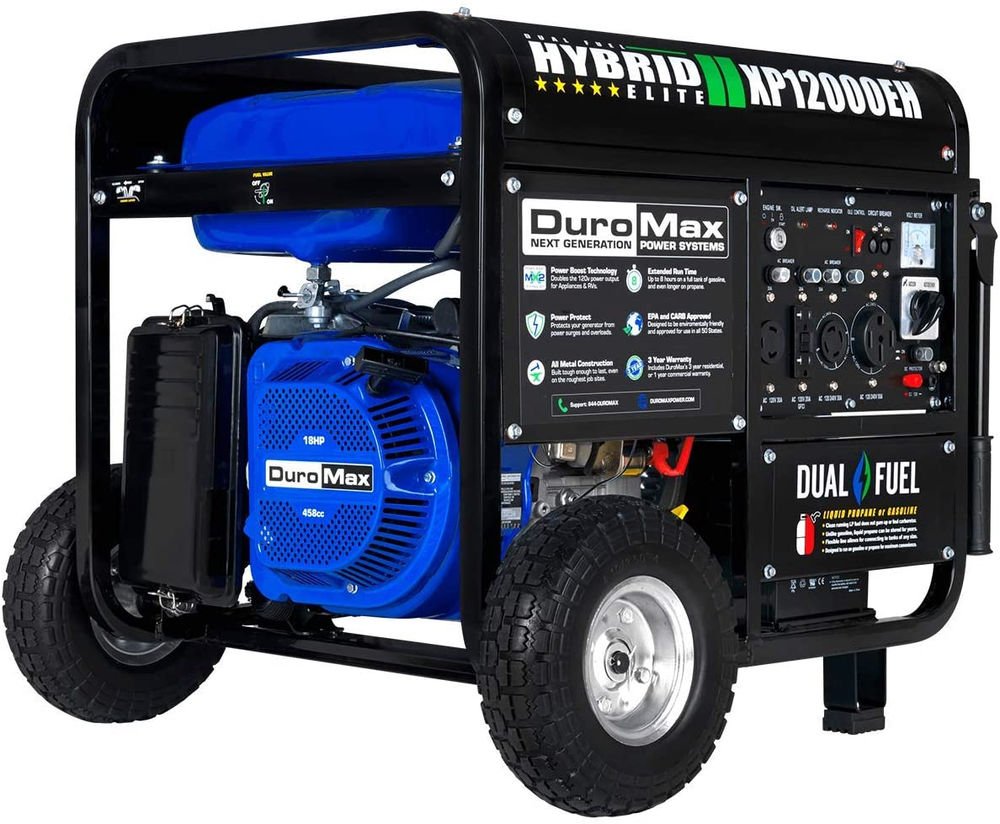
When you need power on the go, or just for a select few items at home, a portable generator is your flexible friend. These units are designed for manual operation, meaning you'll need to roll them out, fuel them up, and start them when an outage hits.
Pros:
- Versatile: Great for camping, RVing, tailgating, job sites, and emergency home backup.
- More Affordable: Generally much less expensive than standby units.
- Maneuverable: Wheels and handles make them relatively easy to move.
- Simple Setup: Can be used with extension cords for individual appliances, or connected to a transfer switch for more integrated home power.
Cons: - Manual Operation: Requires physical setup and starting during an outage.
- Fuel Management: Typically run on gasoline, which has a limited shelf life and requires careful storage.
- Noise Levels: Can be quite loud, especially larger conventional models (90-100 decibels).
- Limited Power: While larger models can power a good portion of a home, they rarely handle full whole-house loads like standby units.
Inverter Generators: The Quiet, Efficient Evolution
A specialized type of portable generator, inverter generators represent a leap forward in technology. They don't just generate power; they convert it to a stable AC current using advanced electronics. This allows them to adjust their engine speed to match the power demand, making them incredibly fuel-efficient and remarkably quiet.
Pros:
- Quiet Operation: Much quieter than conventional portable generators (50-60 decibels), ideal for residential areas and camping.
- Fuel Efficient: Adapts engine speed to demand, saving on fuel costs.
- Clean Power: Produces stable, "clean" power (low total harmonic distortion), safe for sensitive electronics like laptops and medical equipment.
- Compact & Lightweight: Often smaller and lighter than conventional portables of similar output.
- Parallel Capability: Many models can be linked together to double power output.
Cons: - Higher Cost: More expensive than conventional portable generators with similar power output.
- Less Powerful (Typically): While larger inverter models exist, they generally offer less raw power than the largest conventional portables or standby units.
- Still Manual: Requires manual setup and fueling, like other portable generators.
Solar Generators: Silent, Green Power (with Caveats)
More accurately described as portable power stations, solar generators aren't true "generators" in the traditional sense, as they don't generate electricity from fuel combustion. Instead, they store energy in large batteries, which can be charged via a wall outlet or, yes, solar panels. They convert this stored DC battery power into usable AC power for your devices.
Pros:
- Zero Emissions: No gasoline, no fumes, no carbon monoxide—can be used indoors safely.
- Silent Operation: Completely noiseless.
- Low Maintenance: No engine, oil changes, or spark plugs to worry about.
- Renewable Charging: Can be recharged indefinitely with solar panels.
Cons: - Limited Runtimes: Battery capacity dictates how long they can power devices; not ideal for prolonged, whole-home outages.
- Lower Power Output: Typically provide less wattage than fuel-burning generators, limiting the number and type of appliances they can run simultaneously.
- Long Recharge Times: Recharging via solar panels can take many hours, depending on sunlight and panel efficiency.
- Cost: Higher upfront cost for the equivalent usable power compared to small gas generators.
The Golden Question: How Much Power Do You Really Need?
This is where the rubber meets the road. Choosing the right generator hinges on accurately assessing your power requirements. Overestimate, and you'll pay more for a generator larger than you need; underestimate, and you'll be left in the dark for essential items.
The Wattage Worksheet: Your Best Friend
Grab a pen and paper, or open a spreadsheet. List every appliance you absolutely must power during an outage. For each item, you'll need two numbers:
- Running Watts (or Rated Watts): The power an appliance needs to operate continuously.
- Surge Watts (or Starting Watts): The extra burst of power many appliances (especially those with electric motors like refrigerators, sump pumps, and air conditioners) draw for a few seconds when they first start up. Surge watts can be 2-3 times higher than running watts.
How to Find Wattage:
- Check the appliance's label, owner's manual, or manufacturer's website.
- Use a wattage meter (kill-a-watt device) for accuracy.
- Consult online wattage charts (a quick search for "appliance wattage chart" will yield many results).
Calculating Your Total Needs
- Sum Running Watts: Add up the running watts of all the appliances you want to power simultaneously. This gives you your minimum continuous power requirement.
- Identify Largest Surge Wattage: Find the appliance on your list with the highest surge wattage. You'll only account for one surge at a time, as it's unlikely all motor-driven appliances will start simultaneously.
- Generator Size = Total Running Watts + Largest Surge Watts.
Example Scenario:
- Refrigerator: 800 running watts / 2200 surge watts
- Sump Pump: 1000 running watts / 2000 surge watts
- Lights (LED): 100 running watts
- TV: 150 running watts
- Phone Charger: 10 running watts
Calculation: - Total Running Watts (if all are on): 800 + 1000 + 100 + 150 + 10 = 2060 watts
- Largest Surge Wattage (from Refrigerator): 2200 watts
- Estimated Generator Size: 2060 (running) + 2200 (largest single surge) = 4260 watts (or 4.2 kW).
You'll then want to round up to the nearest available generator size. For this example, a 5,000-watt (5kW) portable generator would likely be sufficient. For most homes looking to power critical circuits, a 20kW generator is a common benchmark for whole-home needs.
Matching Your Generator to Your Outage Reality
The frequency and duration of power outages in your area should heavily influence your generator choice. There's no one-size-fits-all answer.
Frequent, Prolonged Power Outages (e.g., Rural areas, storm-prone regions)
If you regularly experience multi-day blackouts, or if severe weather is a common occurrence, you need a robust solution.
- Recommendation: A home standby generator is the gold standard here. Its automatic operation and ability to power an entire household (including central heat/AC, well pumps, etc.) without intervention is invaluable. You'll never have to worry about cold food or frozen pipes.
- Alternative (if standby isn't feasible): A large portable generator or a large inverter generator connected to a circuit breaker panel via a manual transfer switch. This requires more manual effort but offers substantial power for critical systems. Professional installation of the transfer switch is a must.
Occasional, Sustained Outages (e.g., Suburban areas, moderate storm activity)
For those who see outages a few times a year that might last for several hours or even a day, a manual setup can be a cost-effective compromise.
- Recommendation: A large inverter generator or a large portable generator. These units provide enough power for essential appliances like a refrigerator, some lights, a microwave, and a well pump. While they require manual setup, they save thousands compared to standby units. A manual transfer switch installation is still highly recommended for safety and convenience.
Rare Power Outages (e.g., Urban areas, peace of mind for a few items)
If outages are rare and usually short-lived, or if you primarily want to keep a few key items running, you don't need a massive system.
- Recommendation: A midsized or small inverter generator. A midsized unit can comfortably run your refrigerator and perhaps a window AC or a few power-hungry kitchen appliances. Smaller recreational models are perfect for keeping the fridge, lights, phone chargers, and a small TV going. They are compact, quiet, and easy to transport for other uses.
Fueling Your Power: Deciding on the Right Source
Generators run on various fuel types, each with its own advantages and considerations. Your choice impacts convenience, cost, storage, and environmental footprint.
Gasoline
- Prevalence: Most common fuel for portable generators.
- Pros: Readily available at gas stations. High energy density.
- Cons: Limited shelf life (even with stabilizer, typically 3-6 months). Requires careful storage. More volatile and flammable. Fumes.
Propane (LP Gas)
- Prevalence: Common for standby generators and some portable models.
- Pros: Clean-burning, longer shelf life than gasoline. Tanks are easy to store and exchange/refill.
- Cons: Less energy-efficient than gasoline or diesel, meaning you'll burn more propane for the same power output. Tanks need to be refilled, which can be difficult during widespread outages.
Natural Gas
- Prevalence: Exclusively for home standby generators.
- Pros: Directly tied into your home's gas line, providing a virtually limitless fuel supply during an outage (assuming the local gas supply remains uninterrupted). No on-site storage needed.
- Cons: Less energy-efficient than other fuels. Availability depends on existing natural gas infrastructure.
Diesel
- Prevalence: Popular for larger portable, industrial, and some home standby generators.
- Pros: Excellent fuel economy and high power output. Diesel fuel can be stored longer than gasoline. Lower fire hazard compared to gasoline.
- Cons: Diesel generators often have a higher upfront cost. Diesel exhaust can be more odorous. Requires proper ventilation.
Solar
- Prevalence: Used by solar generators/portable power stations.
- Pros: Free, clean, and renewable energy. No emissions, no noise, no fuel storage.
- Cons: Limited runtimes and power output. Dependent on sunlight for recharging. May require battery backup or a secondary fuel-powered generator for prolonged use or lack of sun.
The Cost Factor: What to Expect
Generator prices span a wide spectrum, influenced by type, power output, features, and fuel source. Don's forget installation costs for larger units.
- Home Standby Generators: Expect to pay $2,000 to $6,000 for the unit itself. Installation can add thousands more, potentially ranging from $3,000 to $10,000+, depending on your property's existing infrastructure, location, and gas line availability. New construction with an ideal setup might see installation closer to $3,000.
- Portable Generators: These are the most budget-friendly, starting from a few hundred dollars for small recreational units up to $2,500+ for powerful, feature-rich models.
- Inverter Generators: Generally pricier than conventional portables due to their advanced technology.
- Small (1000-2000W): $450-$1,600
- Midsized (2000-4000W): $500-$2,400
- Large (4000W+): $1,300-$7,000
- Large Portable (Conventional): Typically range from $950-$2,000.
- Solar Generators: Prices vary widely based on battery capacity and included solar panels, from $300 for small units to $3,000+ for larger, more powerful stations.
Connecting Your Power: The Role of Transfer Switches
Unless you're planning to run a single lamp and phone charger directly from an extension cord, a transfer switch is a critical safety component for home backup power.
What is a Transfer Switch?
A transfer switch is a device that safely connects your generator to your home's electrical panel. It allows you to switch your home's power source from the utility grid to your generator and back again.
Why You Need One:
- Prevents Backfeeding: The most crucial reason. A transfer switch prevents your generator's power from flowing back into the utility grid, which could electrocute utility workers trying to restore power. This is illegal and extremely dangerous.
- Protects Appliances: Ensures your appliances receive the correct voltage and frequency, protecting them from damage.
- Convenience: Instead of running multiple extension cords, a transfer switch allows your generator to power pre-selected circuits in your home directly.
Types of Transfer Switches:
- Manual Transfer Switches: Require you to manually flip a switch to disconnect from the grid and connect to the generator. Common with portable and inverter generators.
- Automatic Transfer Switches (ATS): Found in home standby generators. These sense a loss of utility power and automatically switch to generator power within seconds, and then switch back when grid power returns.
Professional Installation: Always have a qualified electrician install a transfer switch. This ensures it's done safely, correctly, and in compliance with local electrical codes.
Safety First: Operating Your Generator Responsibly
Generators provide vital power, but they can be dangerous if not operated correctly. Carbon monoxide poisoning, electrocution, and fire hazards are real risks.
- Never Operate Indoors: This is the most critical rule. Gasoline, propane, and diesel generators produce carbon monoxide (CO), an odorless, colorless, and lethal gas. Never operate a generator in a garage, carport, basement, shed, or any enclosed or partially enclosed space.
- Maintain Safe Distance: Operate your generator a minimum of 20 feet from your home (or any building), with the exhaust directed away from windows, doors, and air conditioning units.
- Install CO Detectors: Have battery-operated carbon monoxide detectors installed inside your home, and check their batteries regularly.
- Use a Transfer Switch: As discussed, this prevents dangerous backfeeding and ensures safe power distribution within your home. Never "backfeed" by plugging the generator directly into a wall outlet.
- Keep it Dry: Generators should be kept dry. If operating in wet conditions, use a generator tent or canopy designed for outdoor use, ensuring proper ventilation.
- Proper Fuel Storage: Store fuel in approved containers, away from living areas and heat sources.
- Cool Before Refueling: Never refuel a hot generator. Let it cool down completely to prevent fires.
- Regular Maintenance: Follow the manufacturer's maintenance schedule for oil changes, spark plug checks, and air filter cleaning. A well-maintained generator is a safer, more reliable generator.
- Grounding: Check your owner's manual for specific grounding instructions.
Beyond the Basics: Features That Matter
Modern generators come with a variety of features that enhance convenience, safety, and performance.
- Automatic CO Shutoff: A crucial safety feature that automatically shuts down the generator if dangerous levels of carbon monoxide are detected near the unit.
- Electric Start: Say goodbye to pull cords! An electric start allows you to start the generator with a simple push button, key, or even a remote control. Some even have smartphone app control.
- Low-Oil Shutoff: Protects your generator's engine by automatically turning it off if the oil level drops below a safe operating point, preventing costly damage.
- Fuel Gauge: A simple but incredibly useful feature that lets you monitor fuel levels at a glance, helping you plan for refueling before you run out.
- Noise Level: Measured in decibels (dB), this can range from a quiet hum (50-60 dB for many inverter generators) to a roaring engine (90-100 dB for some conventional portable units). Consider your neighbors and your own comfort.
- GFCI Outlets: Ground-Fault Circuit Interrupter outlets offer added electrical safety, especially when using the generator outdoors or in wet conditions.
- Wheel Kits/Portability: For portable generators, sturdy wheels and a folding handle are essential for easy transport.
- Parallel Capability: For inverter generators, this allows you to connect two smaller units together to double your power output when needed.
Making Your Final Decision: A Step-by-Step Approach
Feeling a little overwhelmed by all the choices? Let's break down your decision process into actionable steps:
- Assess Your Outage Risk & Needs:
- How often do you lose power? How long do outages typically last?
- What are your absolute essential items (fridge, heat, medical, well pump, internet)?
- What "nice-to-haves" would you like to power?
- Calculate Your Power Requirements:
- List all desired appliances.
- Find their running watts and largest single surge wattage.
- Add them up to determine your minimum required generator wattage.
- Choose a Generator Type:
- Whole-home, automatic, long-term: Standby
- Versatile, portable, manual, good power: Large Portable
- Quiet, fuel-efficient, clean power, portable: Inverter
- Silent, clean, small loads, short-term: Solar
- Consider Fuel Type:
- Convenience (natural gas line): Standby (natural gas or propane)
- Portability & commonality: Gasoline
- Clean-burning, easy storage: Propane (tanks)
- Heavy-duty, efficient: Diesel
- Eco-friendly, silent: Solar
- Budget for the Total Cost:
- Generator unit price + Fuel costs + (for standby/transfer switch) Professional installation + Maintenance.
- Prioritize Safety Features:
- Automatic CO Shutoff, Low-Oil Shutoff, GFCI outlets are all highly recommended.
- Consult an Electrician (if considering standby or transfer switch):
- Before purchasing a large generator or a transfer switch, get a professional assessment of your home's electrical system and local codes.
Empower Your Home: Don't Wait for the Next Outage
Choosing a home backup generator is a proactive decision that pays dividends in comfort, safety, and peace of mind. By carefully evaluating your needs, understanding the different types, and prioritizing safety, you can select a system that reliably keeps your home powered when the grid goes dark. Don't let the next storm catch you unprepared; take control of your power future today.